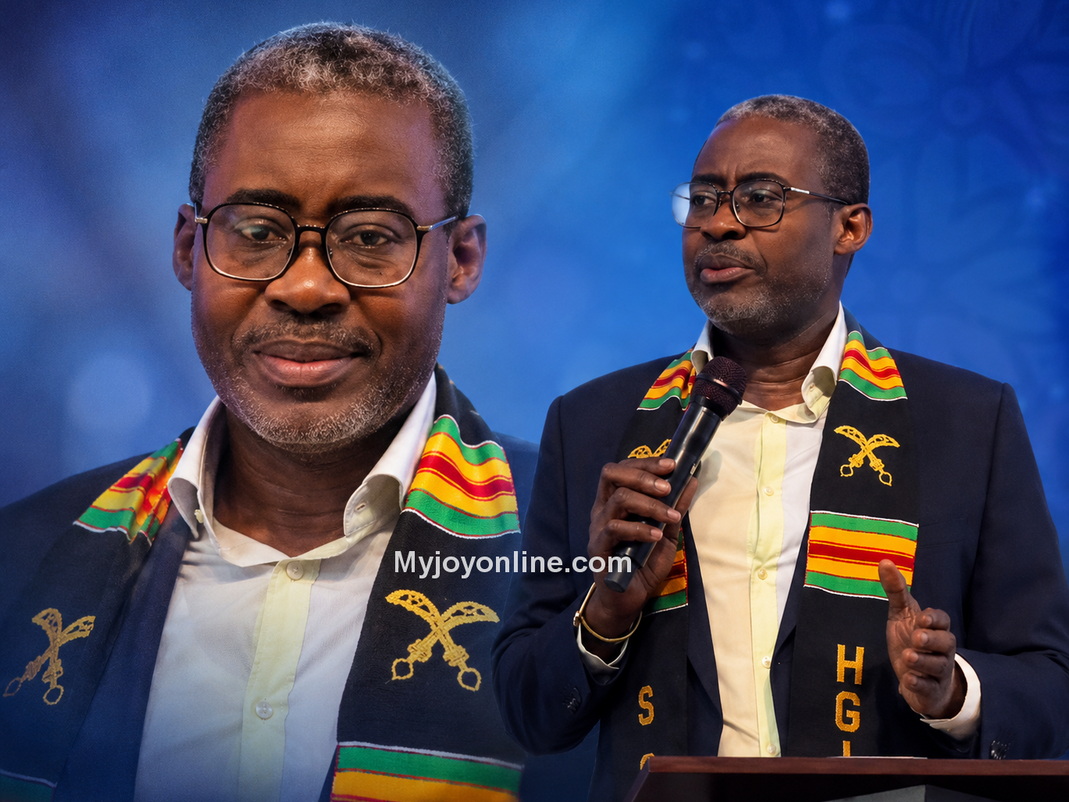
When lawyer Ace Anan Ankomah stood before the graduating Class of 2026 at SOS-Hermann Gmeiner International College (SOS-HGIC), he did not begin with his accomplishments in law, public service or corporate governance. Instead, he took his audience back 40 years to a struggling secondary school student who had little reason to believe success lay ahead.
That student, he revealed, was himself.
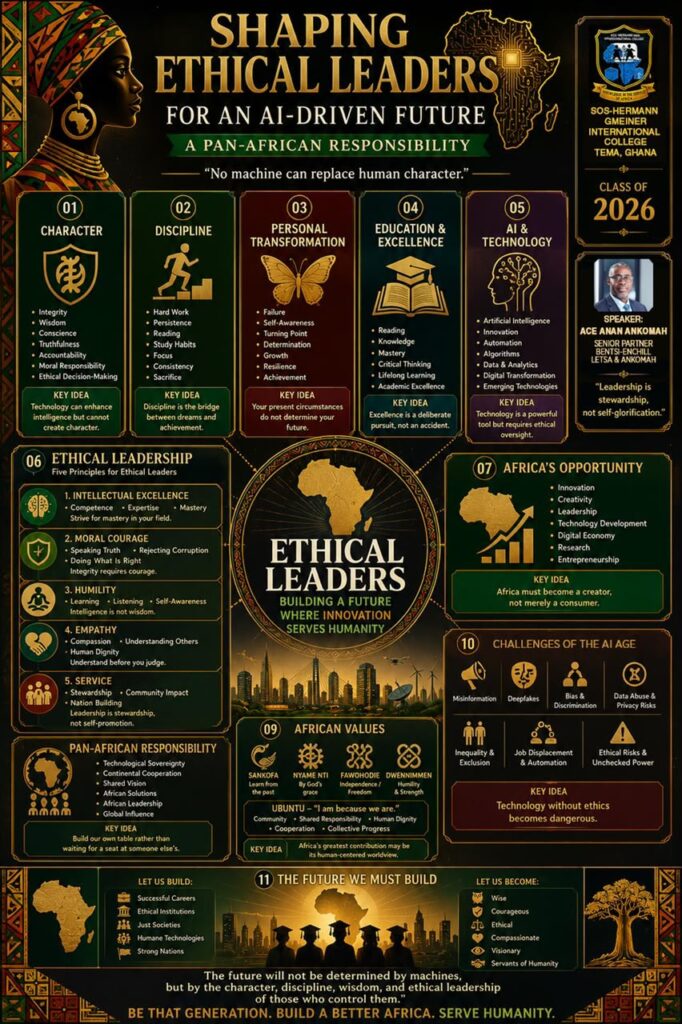
Delivering the commencement address on the theme, “Shaping Ethical Leaders for an AI-Driven Future: A Pan-African Responsibility,” Ace Ankomah blended reflections on artificial intelligence with a deeply personal account of failure, resilience and self-discipline, urging graduates to recognise that character and hard work remain more important than talent alone.
For many in the audience, the most compelling lesson came not from his warnings about technology but from the remarkable transformation he described from an academically weak student to the best A-Level graduate at Mfantsipim School.
“I would have voted for myself”
Ace Ankomah recounted that during most of his first five years at Mfantsipim, he drifted through school without direction.
“Had we voted for the classmate least likely to succeed, I would have probably voted for myself; and won,” he told the graduates.
His academic performance deteriorated to the point where he was assigned to Form 4G2, a class reserved for the weakest students academically.
To compound his difficulties, he was also a stammerer, a challenge he says he still lives with today.
The experience forced him to confront an uncomfortable reality.
He described that period as a turning point when he realised he was failing and that unless he changed course dramatically, his future prospects would be bleak.
Rather than resign himself to failure, he decided to rebuild himself through reading and disciplined study.
The power of reading
According to Ace Ankomah, his transformation began with a simple principle that continues to guide him today: “You only know what you study, and you cannot study what you do not read.”
That discovery led him to immerse himself in books. He said he read relentlessly to make up for lost time, eventually securing admission into Sixth Form by what he described as the narrowest of margins.
His study habits became even more rigorous afterwards.
When his father bought him most of the prescribed texts for Sixth Form, Ace Ankomah said he devoured them repeatedly until he made another important discovery.
“If I read something ten times, I was unlikely to forget it. So, ten times I read,” he said.
To this day, he advises law students to read every text at least ten times, arguing that many students blame a lack of time when the real obstacles are often distraction, laziness or excessive sleep.
He also developed a disciplined system for preparing for examinations by organising past questions according to topics and using them to guide his studies.
Writing down a dream
Ace Ankomah told graduates that success began accelerating when he started setting clear goals.
At the age of 16, he predicted his own A-Level grades and set a specific ambition: to study law at the University of Ghana and live in Annex A of Legon Hall.
He wrote those goals and personal mantras inside every book he owned.
One of those guiding principles was simple: “Failure finds no home where discipline and dedication live.”
“Yes, I prayed. But I worked even harder than I prayed,” he recalled.
The results exceeded even his own expectations.
The student who had barely entered Sixth Form emerged in 1986 as Mfantsipim’s best A-Level student, earning one of the school’s highest academic honours.
“Everyone was shocked: me first, and to borrow from my best friend, ‘me mostest,'” he joked.
Hard work beats talent
Throughout his address, Ankomah repeatedly returned to the importance of discipline.
While acknowledging that hard work does not automatically guarantee success, he argued that success rarely occurs without it.
Drawing on a saying often attributed to basketball coach Tim Notke, he reminded graduates that “hard work beats talent when talent does not work hard.”
He rejected the notion of effortless success, describing achievement as the product of consistent habits, sacrifice and invisible preparation.
“What people often call natural success is usually the visible result of invisible preparation,” he said.
For students facing academic struggles, he offered encouragement rooted in his own experience.
“Real supermen and superwomen do not leap over buildings in a single bound; they take small, determined steps, consistently, over time,” he said.
Lessons from parenthood
Ace also reflected on his experiences as a parent, noting that all three of his children attended SOS-HGIC and eventually entered the legal profession.
One memorable moment came during a parent-teacher meeting when he was pressing teachers about his daughter’s academic performance.
Suddenly, a familiar voice reminded him of his own past.
“Be quiet, Ace. Weren’t you a late starter yourself?” the voice said.
To his surprise, the speaker was Mrs Acheamfour-Yeboah, his former Sixth Form history teacher from Mfantsipim, who was now teaching his daughter at SOS-HGIC.
The encounter, he said, reminded him not only of how far he had come but also of the importance of supportive educational systems that help students reach their potential.
Character in the age of AI
Although much of the speech focused on personal discipline and education, Ace Ankomah tied those lessons to the larger challenge facing today’s graduates.
He warned that while artificial intelligence is transforming economies, professions and societies, it cannot replace human character.
Technology, he argued, can amplify intelligence but cannot create wisdom, conscience or moral judgement.
“The defining question of your generation will therefore not be what technology can do, but what kind of people will control it,” he said.
He urged graduates to pursue five guiding principles:
- intellectual excellence,
- moral courage,
- humility,
- empathy and
- service.
He described ethical leadership as Africa’s most important contribution to an increasingly automated world.
A final challenge
As the ceremony drew to a close, Ace Ankomah challenged graduates to become leaders who combine intelligence with wisdom, innovation with conscience, ambition with compassion and leadership with service.
He left them with a personal maxim that he said has guided him throughout his life:
“When others sit, stand.
When others stand, stand out.
When others stand out, be outstanding.
And if others are outstanding, be the standard.”
For the lawyer who once found himself among the weakest students in school, the message was clear: greatness is not reserved for the naturally gifted. It is earned through discipline, perseverance and the willingness to keep moving forward when success still seems far away.
DISCLAIMER: The Views, Comments, Opinions, Contributions and Statements made by Readers and Contributors on this platform do not necessarily represent the views or policy of Multimedia Group Limited.
DISCLAIMER: The Views, Comments, Opinions, Contributions and Statements made by Readers and Contributors on this platform do not necessarily represent the views or policy of Multimedia Group Limited.
Source link