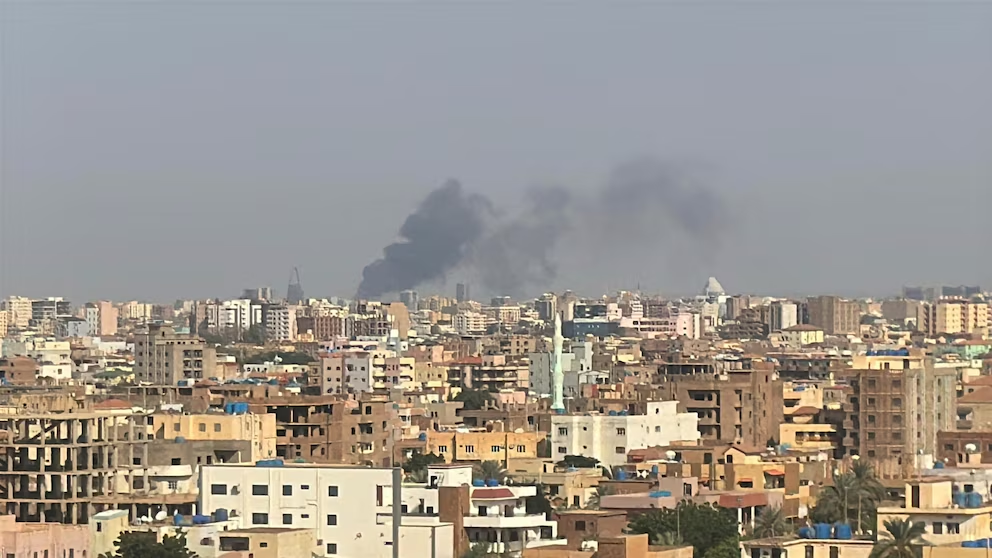

A leading international rights organisation has accused the United Arab Emirates of acting as a critical recruitment hub and transit point for foreign mercenaries. The fighters are allegedly deploying to Sudan to support a paramilitary group accused of widespread atrocities.
Human Rights Watch released a comprehensive report on Tuesday detailing the accusations. The group alleges that a network of Emirati and Colombian security firms covertly recruited former Colombian soldiers. These contractors were reportedly funnelled through the UAE military infrastructure. They then arrived on the frontlines of Sudan’s civil war to bolster the Rapid Support Forces (RSF).
The UAE government has strongly denied the accusations. The Gulf state maintains that any such operations violate local laws and completely lack state authorisation.
A Network of Covert Recruitment and Transit
The HRW investigation spanned interviews with Colombian contractors conducted between March and September 2025. According to the findings, the pipeline targeted former military personnel under the guise of specialised technical employment.
An Abu Dhabi-based firm named Global Security Services Group allegedly advertised “drone pilot work in Africa.” UN experts previously noted that an Emirati national, Mohammed Hamdan Al-Zaabi, chaired the firm.
Contractors detailed highly unorthodox transit procedures designed to avoid official scrutiny.
“They didn’t stamp our passports,” a mercenary told the rights group, describing his journey through the UAE capital, Abu Dhabi. “We went in and went out, and there was a bus waiting for us to take us to a military base.”
HRW identified key transit nodes used to move fighters into the conflict zone. These locations included airports across the UAE, Libya, Chad, and Somalia. The findings build upon previous research by the Conflict Insights Group. That organisation recently highlighted the presence of Colombian contractors operating inside Sudan’s western region of Darfur.
Tactical Training and Domestic Facilities
The investigation alleges that the contractors received specialised training at prominent Emirati military facilities. These locations included bases in Ghiyathi, Al Wathba, and the Al Dhafra region. Once prepared, the men were deployed to Sudan to provide the RSF with critical technical capabilities.
Contractors reportedly served as infantry, artillerymen, drone pilots, and vehicle operators. Open-source intelligence and leadership admissions appear to verify the deployment.
In February, RSF commander Gen. Mohammed Hamdan Dagalo acknowledged the setup. He stated in video comments that Colombian mercenaries have aided his group in operating drones.
Furthermore, a United Nations panel of experts reported to the UN Security Council in September. They stated that Colombian mercenaries fought across multiple operational theatres. These zones included Khartoum, Omdurman, Darfur, and Kordofan.
One unnamed contractor quoted by HRW admitted he trained RSF recruits at camps around Nyala, the provincial capital of South Darfur. He noted that many recruits were “young children.”
Eyewitness Accounts of Battlefield Atrocities
The presence of foreign contractors links them directly to theatres of gross human rights violations. International outrage intensified following the RSF’s violent capture of the strategic Darfur city of el-Fasher. UN-commissioned experts stated that the offensive bore “the hallmarks of genocide.”
The United Nations Human Rights Office estimates the human toll of that assault. Officials state that more than “6,000 were killed within the first three days of the RSF offensive.”
Residents and survivors placed foreign fighters directly at the scenes of these mass killings.
“In November and December 2025, six el-Fasher residents told Human Rights Watch they saw people they believed were Colombians in the city in October 2025, when mass killings were taking place,” the HRW report states.
A survivor detained by the RSF reported seeing “foreign fighters” who “looked on silently” as RSF fighters opened fire on crowds. Another resident recalled seeing “white fighters” alongside RSF units during the execution of three individuals.
“They were there when the executions happened, but they didn’t execute,” the witness stated.
Documented Weaponry and Financial Ties
Battlefield recoveries provide further evidence for the allegations. HRW reported that munitions belonging to the UAE armed forces were discovered inside Sudan following the capture of several Colombian mercenaries.
The rights group traced tracking data for the weapons. They found some of the munitions were manufactured in Serbia and Bulgaria, but purchased directly by the UAE.
“The recruitment of Colombian private military contractors adds to a growing body of evidence that the UAE provides military support to the Rapid Support Forces, which have repeatedly carried out heinous atrocities in Sudan,” said Mausi Segun, executive director of HRW’s Africa Division.
The phenomenon has drawn sharp condemnation from Colombia. Colombian President Gustavo Petro previously called the mercenaries “spectres of death” and described their recruitment as a “form of human trafficking”.
Blanket Denials and Legal Distancing
The Emirati Ministry of Foreign Affairs issued a firm rejection of the report’s conclusions. The ministry stated that the nation maintains strict protocols against foreign fighter facilitation.
“The UAE does not permit its territory to be used for the recruitment, training, financing or transit of foreign fighters to any conflict, including Sudan,” the ministry said in a statement.
Emirati officials emphasised that any domestic or foreign entity operating such a network would face severe legal consequences.
“Where allegations have been made about specific entities, the relevant authorities have investigated, including by making inquiries with companies cited in open sources,” the foreign ministry said.
“Any individual or entity – Emirati or foreign – that was to act in a way that could reasonably be interpreted as providing operational support to an armed non-State actor would be doing so without state authorisation, in violation of Emirati law, and would be subject to criminal investigation and prosecution.”
The ministry added that the country “remains committed” to working with international partners. They aim to “alleviate the suffering of the Sudanese people” by securing a lasting ceasefire. They also hope to help create an “inclusive, Sudanese-owned transition to an independent civilian-led government”.
International Pressure and the Humanitarian Toll
The conflict erupted on April 15, 2023. It stemmed from a bitter power struggle between the Sudanese army and the RSF. The paramilitary group originally evolved from the Janjaweed militias, which were responsible for widespread atrocities in Darfur during the early 2000s.
The human cost of the war continues to mount rapidly. The Armed Conflict Location and Event Data Project tracks at least 59,000 fatalities. However, other estimates suggest more than 150,000 people are believed to have died from the violence. More than 12.9 million people remain internally and externally displaced.
The international response to the mercenary pipeline has triggered selective punitive measures. The United States imposed sanctions on a network of individuals based in Bogota. The U.S. accused the group, primarily of Colombian nationality, of recruiting former soldiers for the Sudan conflict.
However, Washington has stopped short of directly penalising the UAE despite mounting reports of its logistics role. Rights advocates are now calling for an immediate suspension of military cooperation with the Gulf state.
“Other countries need to stop accepting the UAE’s blanket denials of support to the RSF, which fly in the face of the facts, and should put an end to its impunity for war crimes and crimes against humanity,” Segun said.
Paramilitary Accountability and Next Steps
RSF leadership has pushed back against claims of institutional impunity following global condemnation. RSF leader Gen. Mohamed Hamdan Dagalo last year declared an investigation into violations committed by his soldiers during the capture of el-Fasher.
It remains unclear whether internal paramilitary reviews or unilateral U.S. financial sanctions will slow the influx of foreign personnel. Human rights groups are now urging the European Union, the United Kingdom, and the United Nations to act. They want direct diplomatic pressure applied to Gulf partners to disrupt the private contractor pipeline entirely.
Continental Ramifications and the Call for African Sovereignty
The exposure of extra-continental mercenary networks highlights a critical breakdown in regional security architectures. For audiences across Ghana and the broader African continent, external military interference threatens to undermine continental self-determination and deepens long-term state fragmentation.
The African Union (AU) Peace and Security Council has repeatedly expressed grave concerns over external meddling. Critics point out that parallel diplomatic tracks led by outside powers frequently dilute continental leverage. The use of proxy forces and outsourced combat personnel complicates the AU’s mandate of finding local, democratic solutions to African conflicts.
Beyond geopolitical instability, the prolonged war strains West African and continental logistics. Displacement on this scale fuels regional migration pressures and resource competition. The flow of unaccounted munitions and private security networks sets a dangerous precedent. This reality alarms security analysts who fear the normalisation of corporate warfare on African soil.
DISCLAIMER: The Views, Comments, Opinions, Contributions and Statements made by Readers and Contributors on this platform do not necessarily represent the views or policy of Multimedia Group Limited.
DISCLAIMER: The Views, Comments, Opinions, Contributions and Statements made by Readers and Contributors on this platform do not necessarily represent the views or policy of Multimedia Group Limited.
Source link