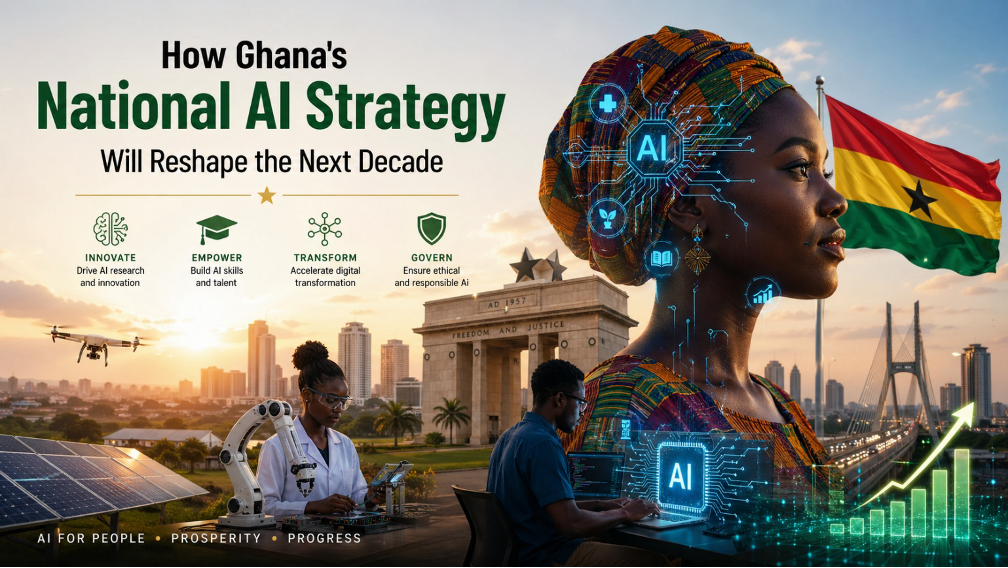
Ghana has a new ten-year plan, and it is built on Artificial Intelligence (AI).
On 12 December 2025, the Ministry of Communication, Digital Technology and Innovations released the Republic of Ghana National Artificial Intelligence Strategy 2025–2035. The document runs to 84 pages. The ambition behind it can be stated in a single line. By 2035, AI is meant to add 500 billion cedis to Ghana’s economy.
That is not a small number. Ghana’s entire GDP in 2025 is approximately 1.4 trillion cedis (IMF, 2026). The Strategy is asking artificial intelligence — a technology most Ghanaians have only encountered through ChatGPT or mobile money fraud alerts — to deliver value equivalent to more than a third of the current economy within a single decade. It is the boldest technology commitment Ghana has made since the ICT for Accelerated Development policy of 2003.
This article is the first in a thirty-week public education series running on myjoyonline and the Business and Financial Times. Each week, we will unpack one part of the Strategy: a pillar, a sector, a target, a risk, a stakeholder. The aim is simple — to give Ghanaians the information they need to engage with the AI decade as participants, not spectators. This first article tells you what the Strategy says, what the headline numbers mean, and why the bet matters.
The Mission and the Vision
The Strategy opens with a Mission Statement: “To harness AI for inclusive growth across all sectors and to improve the lives of people in Ghana, becoming a trailblazer for AI leadership in Africa and beyond” (MoCDTI, 2025, p. 11). Five things matter in that sentence.
The verb “harness” tells you Ghana intends to use AI actively, not consume it passively. The phrase “inclusive growth” tells you the Strategy must deliver for the 39.9 percent of Ghanaians who live in rural areas, not just the urban majority (DataReportal, 2025). The phrase “across all sectors” tells you AI is not confined to fintech — it covers healthcare, agriculture, transportation, public administration, lands, environment and culture. The phrase “improve the lives of people in Ghana” tells you welfare matters, not just GDP. And the word “trailblazer” tells you Ghana is not asking to participate — it is asking to lead.
The Vision is even more direct: “Ghana 2035: The AI-Powered Society.”
“By 2035, people living in Ghana will experience a transformed society where AI advances the potential of people, government, businesses and systems.”
Three things sit inside that vision. First, societal transformation — AI changes everyday life, not just the economy. Second, capability — Ghanaians themselves possess the skills to operate at the global frontier. Third, leadership — Ghana becomes the leading African AI hub.
Each ambition depends on the others. There is no leadership without capability, and no capability without transformation.
Why 500 billion cedis?
The headline figure deserves close inspection.
Globally, PwC estimates that AI will lift world GDP by 14 percent — about 15.7 trillion US dollars — by 2030 (PwC, 2017). McKinsey’s 2024 analysis of generative AI alone estimates that African economies could unlock up to 100 billion US dollars annually if adoption barriers are addressed (McKinsey & Company, 2024).
Ghana’s 500 billion cedi target by 2035 — roughly 30 to 35 billion US dollars at projected 2035 exchange rates — sits in the upper range of credible forecasts for a sub-Saharan African economy of Ghana’s scale.
It is not the highest target in the world. Saudi Arabia is targeting 135.2 billion US dollars in AI contribution by 2030, equivalent to 12.4 percent of its GDP (PwC Middle East, 2018). India is targeting 4.71 trillion US dollars in AI-driven GDP by 2030 (Digital Planet, 2024).
But Ghana’s target is meaningfully ambitious. It is also dependent on three financing streams that the Strategy commits to in writing.
The first is the National AI Fund, capitalised at 5 billion cedis for 2025–2030 and scaling to 15 billion cedis for 2030–2035 (MoCDTI, 2025, p. 11). This is sovereign capital, drawn in part from royalties on mining and oil channelled through the National Research Fund.
The second is foreign direct investment and local private investment, with a combined target of 200 billion cedis across the full decade.
The third is the Ghana Global AI Summit, designed to facilitate 80 billion cedis of investment into Ghanaian AI companies by 2030 and the formation of 1,000 strategic partnerships.
If all three streams perform, the 500 billion cedi target becomes arithmetically plausible. If any one fails, the projection is at risk.
| THE NUMBERS THAT FRAME THE BET ▸ Ghana GDP (2025): 1.4 trillion cedis (IMF, 2026) ▸ Ghana population: 35.7 million; median age 21.3 years (DataReportal, 2025) ▸ Internet users in Ghana (Jan 2025): 24.3 million; mobile connections 38.3 million ▸ Rural vs urban 4G penetration: 41% rural, 88% urban (MoCDTI, 2025) ▸ Global AI GDP boost projected by 2030: USD 15.7 trillion (PwC, 2017) ▸ Africa’s projected share of that boost: less than 6% ▸ Ghana’s National AI Fund: GHS 5 billion (2025–2030), scaling to GHS 15 billion (2030–2035) ▸ Ghana’s FDI mobilisation target: GHS 200 billion by 2035 ▸ AI’s projected contribution to Ghana GDP by 2035: GHS 500 billion |
Eight pillars, two families
The Vision is operationalised through eight pillars, divided into two families.
The first four are Enablers — the conditions without which AI cannot operate. Pillar 1, Education, commits to training one million AI-ready youth by 2035 and producing 10,000 senior AI researchers. Pillar 2, Youth Employment, connects that pipeline to jobs through fellowships, tax incentives and a Reskilling Fund. Pillar 3, Infrastructure, commits Ghana to expanding its compute capacity to 10²¹ FLOPS by 2027 and 10²⁵ FLOPS by 2035, with energy growing in lockstep. Pillar 4, Data, commits to one trillion tokens of Ghanaian datasets by 2030 and elevates the Data Protection Commission into a full Authority.
The next four are Accelerators. Pillar 5 coordinates the AI ecosystem and convenes the Ghana Global AI Summit. Pillar 6 funds five sectoral pilot projects and pursues ten Ghanaian AI unicorns plus one Ghanaian AGI laboratory. Pillar 7 builds the National Deep Science Institute and the Natural Language Processing Centre of Excellence. Pillar 8 creates GhanaChat — a sovereign large language model trained on government data — and reforms public-sector AI adoption.
The pillars are interlocking, not additive.
If Pillar 1 produces graduates but Pillar 3 has not built compute infrastructure, the graduates emigrate. If Pillar 4 produces data but Pillar 5 has not built ecosystem coordination, the data sits unused. If Pillar 6 funds pilots but Pillar 8 has not opened public procurement to AI start-ups, the largest single buyer in the economy remains closed to them.
This is why the Strategy is built around an anchor institution — the Responsible AI Authority — to coordinate execution across all eight pillars simultaneously.
The Responsible AI Authority
The Strategy recommends that an independent, well-resourced Responsible AI Authority be established within the first year of implementation (MoCDTI, 2025, p. 34).
Three international precedents inform its design: the Singapore National AI Office, the Egypt National AI Council, and the United Kingdom’s Office for AI.
During its launch phase, the Data Protection Commission will serve as a nurturing enclave for the new Authority. The DPC’s experience with the Data Protection Act 2012 (Act 843) and its compliance machinery position it well for the transition.
The Authority’s job is to develop the legislative agenda; coordinate ministries, agencies, the private sector, academia and civil society; conduct quarterly monitoring; develop a Ghana AI Readiness Index; and represent Ghana on global AI governance platforms including UNESCO’s Global Forum on the Ethics of AI, the Global Partnership on AI, and the OECD Working Party on AI Governance.
After three years it will be evaluated for elevation to full commission status. That evaluation point is critical. It is where Parliament gets to ask whether the Authority’s mandate, resourcing and performance justify permanent institutional anchoring.
The seven sectors where AI must deliver
The Strategy targets seven sectors plus an eighth cross-cutting domain of culture: healthcare, agriculture, financial services, transportation, public administration, lands and natural resources, environment and circular economy, and culture.
Each sector was selected for two reasons. It carries material weight in Ghana’s economy or daily life. And it has identifiable AI use cases with a plausible path to adoption.
In healthcare, McKinsey estimates AI could save 150 billion US dollars annually in the United States alone by 2030 (McKinsey & Company, 2024). For Ghana, with one doctor for every 6,355 people (Ghana Health Service, 2023), AI-mediated diagnostic decision support is not a luxury — it is a way to extend specialist knowledge into the regions.
In agriculture, which employs roughly 32 percent of Ghana’s labour force (Ghana Statistical Service, 2024), AI applications in yield prediction, soil management, voice-based advisory in local languages and food fraud detection are already being piloted by Ghanaian companies such as Farmerline.
In financial services, Ghana’s 38.3 million mobile connections and growing fintech sandbox at the Bank of Ghana provide the substrate for AI-enhanced credit scoring, fraud detection and customer service automation.
In transportation, AI-enabled urban traffic management is meant to address what every Accra commuter knows: the city’s roads cost the economy hours of productivity every day.
In lands, in environment, in public administration, the use cases are similarly concrete and locally relevant.
Culture is the eighth domain — and arguably the most distinctive. The Strategy commits explicitly to digitising oral histories and to building AI tools for Twi, Ga, Ewe, Dagbani, Fante, Hausa and Nzema. UNESCO has documented that roughly 40 percent of the world’s languages are at risk of falling out of use (UNESCO, 2022). For Ghana, AI in local languages is both cultural preservation and competitive advantage. An AI that speaks Twi well serves Twi-speaking citizens in ways no monolingual English model ever will.
The risks the Strategy names honestly
A credible vision does not pretend that the road is clear.
The Strategy dedicates an entire section to AI risks: algorithmic bias, lack of transparency, widening digital divides, cybersecurity threats, misuse of personal data, AI-generated disinformation and deep fakes, surveillance misuse, automation-driven job displacement, and dependence on foreign models trained on data that does not represent Ghana’s context (MoCDTI, 2025, p. 25–26).
“Algorithmic bias is not a technical problem when a foreign-trained medical model misdiagnoses a Ghanaian patient because the training data did not include Ghanaian phenotypes.”
These risks have a local texture.
The 2024 Stanford AI Index documented persistent accuracy gaps in foreign-trained medical AI when applied to non-Western populations (Stanford HAI, 2024). The International Telecommunication Union reports that women in developing countries are 17 per cent less likely than men to use mobile internet (ITU, 2024). McKinsey’s 2025 AI report estimates that 40 per cent of employers globally anticipate workforce reductions from AI, particularly in administrative and routine cognitive roles (McKinsey & Company, 2025).
Ghana’s response is institutional, not rhetorical. Pillar 4 strengthens data protection by elevating the DPC. Pillar 8 integrates the grades of Cybersecurity and Data Protection Officer into the civil service. Pillar 1 builds ethics training into AI education. Pillar 2 creates a Reskilling Fund for displaced workers. The Responsible AI Authority is charged with ongoing ethical review.
This layered architecture is consistent with the UNESCO Recommendation on the Ethics of AI, which Ghana adopted in 2021 alongside 192 other Member States (UNESCO, 2022).
The Vision is already in motion
Ghana is not starting from zero.
MinoHealth AI Labs in Accra has developed diagnostic tools in radiology and prenatal care, with a peer-reviewed publication of its methods. Farmerline delivers voice-based agricultural advisory in multiple Ghanaian languages, addressing both literacy and bandwidth constraints. Mazzuma has pioneered AI-enabled mobile money. The BACE Group has built computer vision tools optimised for African facial recognition — an important corrective to global models trained on under-representative datasets.
In academia, the Responsible AI Laboratory at Kwame Nkrumah University of Science and Technology hosts dedicated AI research with Google-sponsored research agreements. The African Institute for Mathematical Sciences trains graduate-level data scientists. The Ghana-India Kofi Annan Centre of Excellence is positioned in the Strategy as the prospective national R&D hub for AI.
In the ecosystem infrastructure space, Ghana NLP has built natural-language-processing resources for Ghanaian languages — a labour-intensive task at the intersection of linguistics, computer science and cultural preservation. Innovation hubs operate in Kumasi (Kumasi Hive, HapaSpace), Takoradi (iCode), the Volta Region (Ho Node), Accra (iSpace, Impact Hub) and beyond.
Google opened its first AI centre in Africa in Accra. Smart Africa, GIZ FAIR Forward, the Foreign Commonwealth and Development Office, UNESCO and the European Commission have all provided technical and financial support.
The Strategy’s job is to scale what already exists — not to start from scratch.
The compact
The Strategy ends with a call to action.
Samuel Nartey George, Minister of Communication, Digital Technology and Innovations, names the actors who must build the AI decade together: government, the start-up ecosystem, academic institutions, traditional leaders, civil society, and international development partners. Each holds a part.
The government’s part is institutional: the Authority, the Fund, the Institute, the legislation, and the public-sector adoption that creates demand. Academia’s part is knowledge: the graduates, the research, the curricula, the partnerships. The private sector’s part is capital and execution: the start-ups, the unicorns, the AGI lab, the FDI. Civil society’s part is vigilance and inclusion. The traditional authorities’ role is one of legitimacy and cultural guardianship. International partners’ contributions are complementary capital and global connections.
In the Twi proverb, sɛ woforo dua pa a, na yɛpia wo — when you climb a good tree, you get a push. The Strategy is the tree. The pushers are the rest of us.
What the President has staked on this
The AI Strategy did not arrive in a political vacuum. It arrived during the first year of President John Dramani Mahama’s second term, sworn in on 7 January 2025.
The President’s reset agenda runs on four pillars: macroeconomic stabilisation, business and investment environment, constitutional review, accountability and the fight against corruption (Ghana News Agency, 2025).
The AI Strategy sits inside two of those pillars at once.
It contributes to macroeconomic stabilisation because GDP growth at scale is the ultimate solvent of Ghana’s debt-to-GDP ratio, projected by the IMF to rise temporarily from 45.3 per cent in 2025 to 53.0 per cent by the end of 2026 in a post-restructuring scenario (GhanaWeb, 2026, citing IMF).
It contributes to the business and investment environment because the 200 billion cedi FDI mobilisation target by 2035 requires precisely the regulatory clarity and investor confidence the President has been rebuilding since inauguration.
The flagship presidential programmes interlock with the Strategy directly.
The 1 Million Coders Programme, which had drawn nearly 150,000 applicants by May 2025 (Ghana Broadcasting Corporation, 2025), feeds the AI Ready Ghana track of Pillar 1. The Adwumawura Initiative, which targets 10,000 new businesses and 20,000 jobs annually, is the entrepreneurial scaffold under Pillar 2’s youth-employment commitments. The 24-Hour Economy, which requires AI-enabled scheduling, predictive maintenance and energy load management, depends on Pillar 3’s compute and energy expansion. The Big Push infrastructure programme of 10 billion US dollars overlaps directly with Pillar 3’s data-centre and broadband commitments (Ghana News Agency, 2026).
This is what gives the Strategy political teeth. It is not a stand-alone technology paper. It is woven into the central economic project of the current administration.
Where the cedis come from
Five billion cedis is real money. Fifteen billion is real money. Two hundred billion is significant by any measure. Where does it come from?
The Strategy proposes three sources for the National AI Fund. The first is direct government allocation in the medium-term expenditure framework. The second is contributions from high-revenue sectors, with explicit reference to royalties from mining and oil channelled through the National Research Fund (MoCDTI, 2025, p. 74). The third is partnerships with international development agencies and philanthropic organisations.
This is a deliberate financial design. It says that the wealth extracted from Ghanaian soil — gold, cocoa, oil — will be partially translated into the intellectual wealth of Ghanaian minds. It also says that AI investment will not depend on a single budget cycle or a single political administration.
On the FDI side, the 200 billion cedi target is broken into three vehicles. The Ghana Global AI Summit, designed as an annual investment-focused event, aims to catalyse 80 billion cedis in investment in Ghanaian AI companies by 2030 alone. Cloud computing partnerships with hyperscalers — NVIDIA, Google Cloud, Microsoft Azure, Amazon Web Services — are designed to bring compute and capital. The proposed Ghanaian AGI laboratory, with funding above 10 billion cedis in mixed local and global participation, is itself a vehicle for international capital.
Whether all three vehicles deliver depends on execution. But the Strategy has put the financing architecture on paper, in numbers, with timelines.
Africa’s window — and Ghana’s
There is a global context to all of this.
Ten countries are projected to capture roughly 70 to 75 percent of global AI value creation by 2030, according to projections from Digital Planet at The Fletcher School (Digital Planet, 2024). The remaining 150-plus nations — home to billions of people — are projected to share less than a third of the AI uplift.
Africa currently hosts less than 5 percent of the world’s hyperscale data centre capacity. The continent imports the vast majority of its software and digital services value, with corresponding losses in employment, tax revenue and data sovereignty.
If Africa does nothing, the AI divide widens. The continent becomes a permanent technology consumer, a data exporter, and a wage-suppressed labour market for foreign AI products.
If Ghana — and other African states with the same ambition — moves now, a different outcome is possible.
McKinsey’s analysis is clear: African economies could unlock up to 100 billion US dollars annually in generative AI value if implementation barriers are addressed (McKinsey & Company, 2024). Telcos alone in Africa could capture 6 to 9.6 billion US dollars in genAI value at scale (McKinsey & Company, 2024).
Ghana is positioning itself for that window. Egypt, Rwanda, Mauritius, Kenya, South Africa, Tunisia and Morocco are all building national AI strategies (OECD, 2024). Ghana’s distinctiveness lies in three commitments: the eight-pillar Enabler/Accelerator architecture, the producer-led research orientation, and the explicit framing of AI as a sovereign capability rather than a foreign service.
The President of the Republic put it directly at the Africa Prosperity Dialogues in February 2025: “The Fourth Industrial Revolution presents Africa with a golden opportunity to leapfrog traditional development models” (Mahama, 2025).
“If Africa does nothing, the AI divide widens. If Ghana moves now, a different outcome is possible.”
What this series will cover
Over the next twenty-nine weeks, this series will examine the Strategy in detail.
Article 2 examines President Mahama’s reset agenda and how the AI Strategy interlocks with it. Article 3 decodes the eight pillars in depth. Article 4 focuses on the Responsible AI Authority. Article 5 explains the UNESCO ethics code that anchors the Strategy. Article 6 walks through Ghana’s AI strengths and weaknesses.
Articles 7 to 12 examine each Enabler pillar. Articles 13 to 18 examine each Accelerator pillar. Articles 19 to 24 examine each target sector. Articles 25 to 30 address risks, inclusion, traditional authorities, the diaspora, continental leadership, and the implementation compact.
By the end of the series, every Ghanaian citizen, parliamentarian, entrepreneur, student, civil servant and traditional authority should have the information needed to engage with the AI decade as a participant rather than a spectator.
The Strategy is on the table. The targets are public. The timeline is fixed. The work begins now.
| WHAT TO ASK YOUR MP THIS WEEK ▸ Has the National AI Fund’s seed capital been appropriated in the next budget? ▸ When will the Responsible AI Authority be established? ▸ When will the Data Protection Commission be elevated into a full Authority? ▸ Does my region have a planned AI innovation hub? ▸ Are local schools getting AI Ready Ghana curriculum support? |
*******
Dr David King Boison is a Maritime and Port Expert, pioneering AI strategist, educator, and creator of the Visionary Prompt Framework (VPF), OBIBINI Multi Intelligence and ADINKRA OMEGA Africa Intelligence, NYAME MIND Intelligence, driving Africa’s transformation in the Fourth and Fifth Industrial Revolutions. Author of Digital Assets Economy, The Ghana Intelligence Economy Playbook, The Nigeria AI Intelligence Playbook, and advanced guides on AI in finance and procurement, he champions practical, accessible AI adoption. As head of the AiAfrica Training Project, he has trained over 2.4 million people across 15 countries toward his target of 11 million by 2028. He urges leaders to embrace prompt engineering and intelligence orchestration as the next frontier of competitiveness.
DISCLAIMER: The Views, Comments, Opinions, Contributions and Statements made by Readers and Contributors on this platform do not necessarily represent the views or policy of Multimedia Group Limited.
DISCLAIMER: The Views, Comments, Opinions, Contributions and Statements made by Readers and Contributors on this platform do not necessarily represent the views or policy of Multimedia Group Limited.
Source link