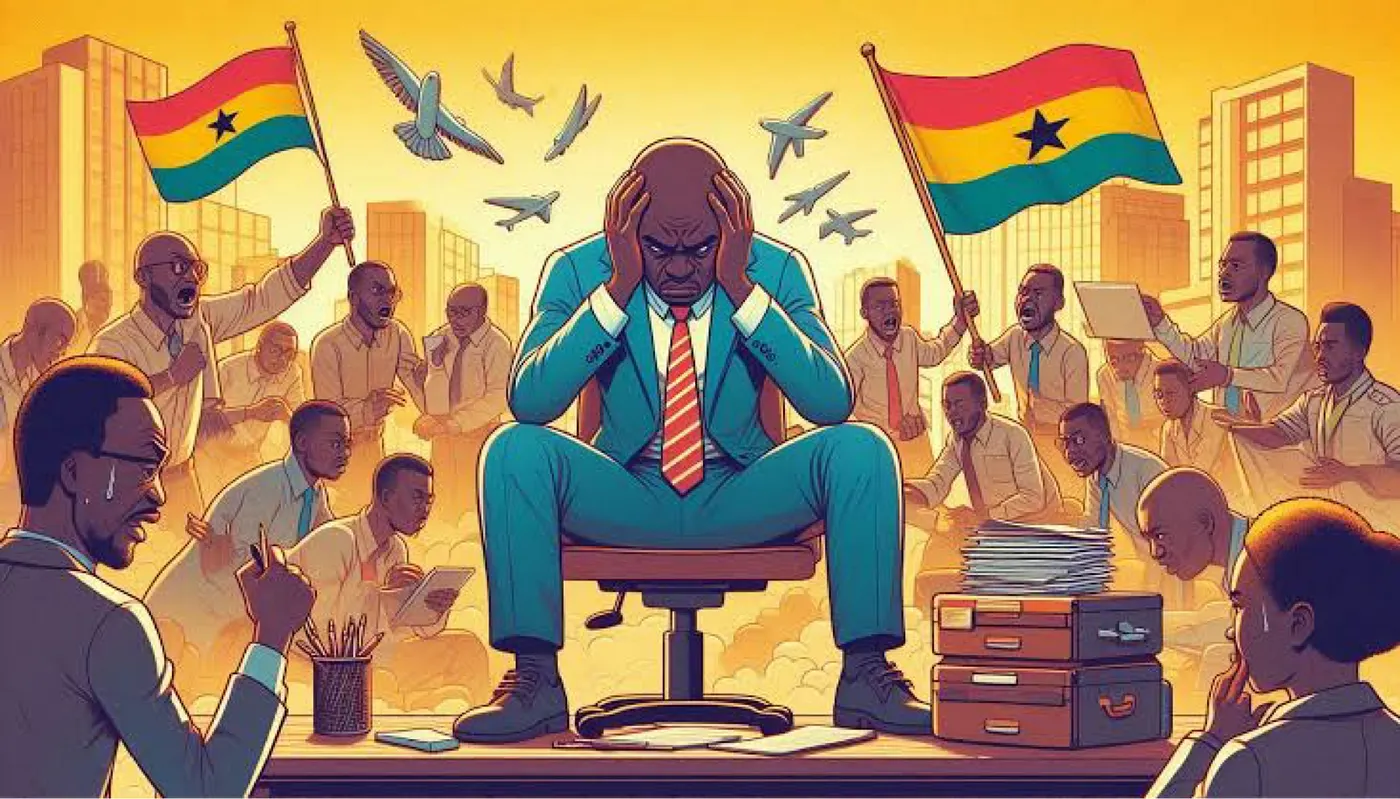
In many workplaces in Ghana, personal emergencies are only justified when there’s total immobility. But what does that mean?
Ghana’s workplace culture will be the end of us.
Stay with me. Last Sunday, I saw a flurry of posts about how important fathers, especially the ‘intentional’ ones, have been in people’s lives. How they show up, support and remain a strong backbone of the family as a unit.
The posts I saw from everybody, whether young, old, men or women, paid tributes to fathers, even those who are not alive, through some of the most touching strings of words I’d seen in a while. But one thing was striking in every one of them; the fathers being celebrated all had had to show up in a particular way which felt safe and empowering for their families, with no exceptions.
Yet, just days before Father’s Day, there was this viral clip of a public exchange between a Ghanaian MP and an MCE. In the clip, the MP who was chairing a hearing by Parliament’s Local Government Committee is seen questioning and almost berating the MCE for apparently being late to the hearing.
The MCE, who was visibly disoriented, explained that his wife had been hospitalised that morning and needed to undergo emergency surgery. As a husband, his natural instincts were for him to stay and provide support for his wife. He reportedly informed the Regional Minister and delegated his Chief Director to replace him, although neither obliged his requests.
This made the MP even more furious, insisting the MCE should have made the entire journey to attend the hearing, sought permission for an early presentation before returning to his wife. After all, he “cannot doctor or nurse” his wife. That thinking is not only incredibly insensitive, it’s also starkly uninformed.
There’s a lot of evidence of how much difference it makes to a person’s recovery journey when they wake up to a familiar face after such procedures. The presence of a loved one reduces post-operative anxiety and stress, which helps prevent complications like disorientation and agitation. But that won’t matter to the MP, who, I must add, is a woman too.
So she went on to berate the MCE, embarrassing him publicly for even tinkering with the idea of putting his wife ahead of his day job as a public servant. This conversation is not about punctuality. It’s isn’t about dedication to duty. It isn’t positive work attitudes. It is about how our work supports us in the most difficult times.
And it’s not even about the MP, because as she herself admitted in the course of the exchange, “we all do it!” And that is the problem. Don’t lose sight of that.
Think about it for a second. Your spouse is admitted to the hospital for an emergency surgery and all your work expects from you is to power through the panic and emotional rollercoaster of waiting to see what happens to one of the most important people in your life, and just work!
Will she make it through? Is she okay? Were there complications? And the millions of other questions you’d be asking yourself. Apart from the sheer insensitivity of the expectation for you to work, how can you even concentrate on the work if you decide to? How?
This man is an MCE, effectively the Mayor of his city and chief government official in his municipality. If he were in New York, he’d be Zohran Mamdani. So if even he can be treated like that, imagine what is expected of the average worker.
But it’s not strange at all. That exchange between the MP and the MCE was a painful reminder of what happens daily in many workplaces across Ghana and the African continent at large. There’s little to no empathy for the people who do the work that keeps the country running. Managers drive employees through the ground and demand everything from them. You either give your whole life to the work or they line up your replacement.
The work takes everything from us and barely gives anything back. And before you talk about the fact that workers are paid a salary, remember, especially for our best talents, they can earn so much more for doing the same thing or even less, elsewhere. That’s why I’m not surprised that our highly skilled talents are leaving the country in droves.
It therefore needs no explanation why Ghana is the 4th most stressful country to work in, south of the Sahara. If we are to retain our best talents and harness their efforts for national development, we cannot continue like this. Work culture must be fit for purpose. And that purpose is to help us live a fulfilling life.
Imagine that every parent (both mothers and fathers) chose their work every time their family needed them. How many of them would be ‘intentional’ and worth celebrating? For a nation so keen on protecting family values and keeping the family unit intact, this cannot be the way we proceed.
THIS MUST CHANGE. It really must.
DISCLAIMER: The Views, Comments, Opinions, Contributions and Statements made by Readers and Contributors on this platform do not necessarily represent the views or policy of Multimedia Group Limited.
DISCLAIMER: The Views, Comments, Opinions, Contributions and Statements made by Readers and Contributors on this platform do not necessarily represent the views or policy of Multimedia Group Limited.