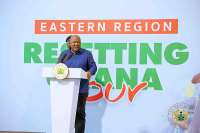
As part of the Resetting Ghana Tour in the Eastern Region, President John Dramani Mahama has engaged citizens in Koforidua, outlining key reforms and development priorities aimed at strengthening governance and improving livelihoods.
Addressing a gathering of residents, traditional leaders, and local officials, the President emphasized renewed efforts to deepen decentralisation. He noted that 80 percent of the District Assemblies Common Fund is now being transferred directly to local assemblies, a move designed to accelerate development at the grassroots level and reduce bureaucratic delays in project execution.
Turning to the economy, President Mahama reported significant progress in stabilisation, citing a reduction in the country’s debt-to-GDP ratio from 67 percent to 45 percent. He explained that this improvement signals a transition from economic stabilisation to a stronger focus on growth and job creation, driven by a new investment-led policy framework.
The President also highlighted ongoing infrastructure development across the country, pointing to road construction projects in the Eastern Region. He referenced the domestically financed Ekyi Amanfrom–Adawso road as an example of government’s commitment to improving connectivity and supporting local economic activity.
In the energy sector, President Mahama commended engineers and technical teams for their swift response in restoring power following recent challenges. He announced plans for further investments aimed at increasing Ghana’s generation capacity to nearly 6,000 megawatts, supported by expanded gas infrastructure and strategic international partnerships.
On healthcare, the President outlined key initiatives under the MahamaCares programme and the Free Primary Healthcare policy. These initiatives, he said, are focused on expanding access to essential services and addressing the growing burden of non-communicable diseases. He also called on traditional authorities to support nationwide screening efforts to improve early detection and treatment.
Agriculture featured prominently in his address, with the President urging greater collaboration through programmes such as Nkoko Nkitinkiti and Feed Ghana. He reaffirmed the government’s commitment to boosting food production, creating jobs, and enhancing the livelihoods of farmers and agribusinesses.
President Mahama concluded by calling for unity and collective effort in driving national development, stressing that the Resetting Ghana agenda is focused on delivering tangible improvements in the lives of all citizens.